
Just yesterday, during my health walk around my neighborhood, I came across one of my friends in the community. She waved at me, walked over, and said hello. I sensed something off about her demeanor. When you take your walks at the same time on the same days, you find out very quickly that your routines match those of one or two individuals in your community. And when this happens, a friendship can form. And with friendship comes understanding and familiarity.
I know what she looks like when she's happy. I know the bright look in her eyes when she tells me about her son's latest accomplishments in school or her daughter's graduation. On the other side of this, you begin to get a feel for when your friend is sad. This is what it means to be human, to share in the emotions of those you interact with on a regular basis. I think they call it empathy or sympathy, I always get them mixed up. On this day she looked quite down. I asked how she was and she gave me a quick reply, turned it around with a big smile and asked me how I was doing. I caught the trick. Shifting the focus from herself to avoid an uncomfortable conversation. But I was not deterred. "Tell me what's wrong?" After some eye rolling she confessed that the increase in grocery prices has made life increasingly difficult for her. She then quickly declared that she refuses to complain, that all of her colleagues are struggling but she doesn't want to dwell on the issue like them. Inflation is happening to everyone and we all have to find a way to deal with it. I could tell she felt some relief unburdening herself but the interaction left me quite disturbed.
When did inflation become an act of God?
How did our communities begin to combine natural events, like rainfall, with economic "forecasts" in the same categories?
And then it struck me. The current economic system, based purely on money, its conjuring and distribution, has assumed the role of religion. It is shrouded in a narrative of mystery and inevitability that renders the human individual powerless. The story being told of money is one of the sublime, an awe inspiring object of extreme power and mystery. We all mindlessly ape for it but fail to understand exactly how it works.
The world we live in today has unknowingly laid the foundation for a new spiritualism that is stripping away the agency of its congregation. We are at the precipice. We stand dangerously at the same position as Martin Luther did 500 years ago. A world ruled by a clergy, protected by jargon, misdirection and power. And power, as we all know, ultimately leads to corruption.
We are taught to think of money as a hard, physical fact of life, as real as gravity, as neutral as arithmetic. But money is not a thing. It is a story. And like every powerful story a society has ever told itself, it has produced a class of people whose job is to author that story, interpret it, and guard it from doubt. We call them economists, central bankers, and financiers. It would be more honest to call them priests.
This is not a metaphor stretched for effect. The resemblance is structural. Once you see how money actually works, the religious shape of the whole system becomes hard to unsee.
Money is a collective fiction
Pick up a banknote. It can't feed you, shelter you, or keep you warm. It is paper, or these days a number on a screen. Its entire worth comes from one thing: a shared agreement that it counts as value. The philosopher John Searle called this an "institutional fact," something that is real only because a community collectively agrees to treat it as real. A twenty dollar bill has value for the same reason a king has authority or a border exists: enough people believe it does and act accordingly. I want you to pause here and reflect on the preceding words. Money is only as real as we make it, through our consent. We give it power when we submit to the rules others have drawn around it. Think of children in a playground making up rules for a game they invented. Money is no different.
This is easy to dismiss until you watch the belief fail. In Weimar Germany in 1923, and in Zimbabwe in 2008, people carried cash in wheelbarrows and then stopped accepting it entirely. The paper had not changed. The story had collapsed. When the shared belief evaporates, money instantly reverts to what it physically is, paper and pixels. That is the tell of a fiction: it works only as long as it is believed, and it can break.
Most people don't even know how money comes into existence. This isn't a criticism. We aren't taught the intricacies of the financial system that underpins our whole existence in this modern world. I had to spend hours scouring the internet for academic papers to actually back up what I was reading. It sounded like fiction. How can money be so simply "made out of thin air"? The common assumption is that governments print it. But in modern economies, the overwhelming majority of money is created by private commercial banks, out of nothing, when they make loans. This isn't a fringe claim. The Bank of England stated it plainly in a 2014 paper: whenever a bank makes a loan, it creates a new deposit in the borrower's account, and with it, new money. The money did not exist a moment before. This is one of the most consequential facts about the system we all live inside, and it is almost never taught. That absence is the first clue that we are dealing with a mystery, knowledge deliberately kept esoteric. Esoteric knowledge is something meant to be understood by, or intended for, only a small group of people with specialized education or interest. There is power in a mystery. Knowledge of a thing's inner workings can sometimes strip it of its aura. It also robs those in the know of their authority.
Every durable fiction breeds a clergy
A shared fiction at the scale of an entire civilization is fragile. It has to be maintained. Someone must issue the sacred objects, define what counts as orthodoxy, interpret the signs, perform the rituals that renew public belief, and discipline the heretics. Religions solved this problem thousands of years ago by creating a priesthood, a special class with privileged access to the mystery, speaking a language the congregation cannot follow, whose pronouncements carry the weight of the divine.
The money system solved the same problem the same way. The opacity is not an accident. Like Latin liturgy in a church full of people who spoke no Latin, the incomprehensibility of finance is part of what sustains both the awe and the monopoly of those who administer it. Three things turn an ordinary official into a priest: a monopoly on esoteric knowledge, the power to make things true simply by pronouncing them, and a congregation that mistakes the priest's authority for a property of the sacred object itself. The money clergy has all three.
The high priests: central bankers
At the top sit the central bankers, the closest thing we have to a pontifical class. They literally conjure money into existence. They interpret the sacred signs, inflation, employment, "the data," and issue oracular statements that are then parsed, word by word, for hidden meaning. The financial world's obsessive practice of "Fed watching" is exegesis in everything but name: scholars poring over a sacred text for clues to the future.
Crucially, their power is performative. When a central bank chair says a sentence, trillions of dollars move, not because the sentence describes a reality that already exists, but because the congregation believes the words will come true and acts to make them so. This is why central bankers cultivate deliberate vagueness. Alan Greenspan, who chaired the U.S. Federal Reserve for nearly two decades, once joked that if he had made himself clear, he must have misspoken. He openly prized being unintelligible. An oracle that speaks too plainly loses its power.
The theologians: academic economists
Below the high priests are the theologians, the academic economists who produce and police the doctrine. Their great function is to take political choices and dress them as natural laws. When a contestable decision about who gets what is restated as a mathematical inevitability, "the market clears," "there is no alternative," a human choice has been converted into scripture. The theologians decide what is orthodox and what is heresy, train the next generation of clergy, and confer legitimacy on the whole enterprise.
Consider the highest honor the profession can bestow. Most people call it the Nobel Prize in Economics, and assume it sits beside the prizes for physics, medicine and peace that Alfred Nobel established in his will. It does not. There is no Nobel Prize in Economics. The award is the Sveriges Riksbank Prize in Economic Sciences, created in 1968 and funded by the central bank of Sweden, then draped in Nobel's name and handed out at the same ceremony. Sit with that. The single most prestigious prize in the discipline, the one that sanctifies certain doctrines as settled truth, was endowed by a central bank. The priesthood funds the prize that canonizes its own theology, and calls it by a saint's name.
The administrators, augurs, and canon lawyers
The rest of the priesthood fills out the hierarchy.
The temple administrators are the commercial and investment banks, who run the daily sacraments: the blessing or denial of credit, the rites of issuance. They mediate access to the sacred substance and take a tithe at every passage.
The augurs are the ratings agencies, market analysts, and the financial press. They read the entrails and pronounce on the future. A downgrade from a ratings agency functions as an anathema, capable of breaking a nation's access to credit overnight. The financial media performs the continuous liturgy, narrating in breathless, devotional language what "the market is feeling" today, keeping the congregation in a state of attentive belief.
The canon lawyers are the bodies that impose doctrine across borders: the IMF, the World Bank, the treasury officials who set the terms of orthodoxy for entire nations and administer penance. What that penance looks like when it is imposed on the nations of Africa, the Caribbean and the Global South is a subject that demands its own reckoning, and it will get one in the next essay in this series. For now, hold onto the shape of it. The same priesthood that governs your grocery bill also decides which countries are permitted to feed their own people. Keep that in view. We are coming back to it.
The priesthood has abandoned its own congregation
It would be one thing if this priesthood simply kept the machinery running. The deeper wound is that its doctrine is not neutral, and somewhere along the way its keepers stopped feeling the pain of the people they were meant to serve. The lie went to their heads. They came to believe their own liturgy so completely that the suffering of ordinary people stopped registering as real. It became noise. A rounding error. An unfortunate lagging indicator.
There is a simple test for the real values of any institution. Ignore what it says it believes. Watch instead how it treats the people who cannot fight back. Judged this way, the money priesthood has quietly abandoned the very congregation whose belief keeps it alive.
Turn on the television at six o'clock. You will be told, in a tone reserved for good news, that the stock market has risen again. Are we serious? The growing number of people sleeping in doorways, the surge in mental health crises tied directly to material insecurity and poverty, the addicts multiplying on the same streets we raised our children on, none of this counts anymore as a measure of whether a community is well? The market is up, and we are instructed to feel reassured, while the people around us are visibly coming apart.
There is a massive stink in our community. Our economy no longer serves the whole of us. It serves the top of the congregation and quietly writes off the rest. And that fact never makes the six o'clock news, because the priesthood that reports the market's mood does not consider our suffering newsworthy. My neighbor on that walk had absorbed the lesson perfectly. Her grocery bill was crushing her, and she had been taught to receive it the way you receive bad weather. Not as something anyone chose. Not as something anyone could be held to account for. Simply as the climate she happened to live in.
That is the real theft. Not only the money, but the sense that anyone is responsible for where it goes, and the sense that she has any standing to ask. A congregation that believes hardship is weather does not petition anyone. It does not organize. It endures, quietly, and blames itself for complaining. This is what a priesthood produces when it has stopped serving its people and started managing them.
The genius and the danger of the system
None of this requires a conspiracy in a back room. The most powerful fictions are not run by cynics. They are run by true believers. Most economists, bankers, and officials are entirely sincere. They worship the totem alongside everyone else while quietly authoring it, and that sincerity is exactly what makes the whole structure so durable. A priesthood that believes its own doctrine will defend it far more fiercely than one that is merely pretending.
And we should be honest that the fiction has real uses. Money is an astonishing technology. It lets strangers cooperate across an entire planet. It compresses a mountain of information into a single number. It coordinates billions of people who will never meet. The point is not that money is fake, or that we should burn it all down. The point is narrower and more unsettling. A small caste holds the authority to define and continually adjust a fiction that everyone else has to live inside as though it were solid ground, and that caste's doctrine quietly encodes a particular arrangement of power while presenting itself as the plain law of nature.
This is the thing worth naming out loud. Who gets to create money. Who decides what counts as fiscal "discipline." Whose belt gets tightened, and whose never does. These are priestly powers dressed up as technical necessity. The language of inevitability is the robe they wear. Strip it away and you find human choices, made by particular people, serving particular interests.
Seeing through the liturgy
The first step in changing any sacred order is to recognize that it is one. The money system feels eternal and physical precisely because almost everyone, everywhere, has agreed to treat it as real. That makes it the most widely observed religion humanity has ever practiced, more universal than any faith that carries a name. Its priests are powerful not because they command armies, but because they administer a belief that we ourselves have already granted.
I have been thinking about my neighbor ever since that walk. The way she caught herself before she could finish complaining. The small, practiced smile she used to fold her hardship back inside, as though her struggle were a private embarrassment rather than a shared condition. She is one of the kindest people I know. She raised good children. She has spent her whole life doing what she was told was right. And somewhere along the way she was handed a story that told her the ground shifting under her feet was nobody's doing, that it was simply the weather of the world, and that the decent thing was to bear it without noise.
I want to see her again on our next walk. I want to tell her that the thing crushing her has a name, and an address, and human hands behind it. That the men who set the price of her worry go home to houses her worry will never touch. That she is not a fool for struggling and she is not a saint for suffering quietly. She is a member of a congregation that has been robbed twice, once of her security, and once of her right to be angry about losing it.
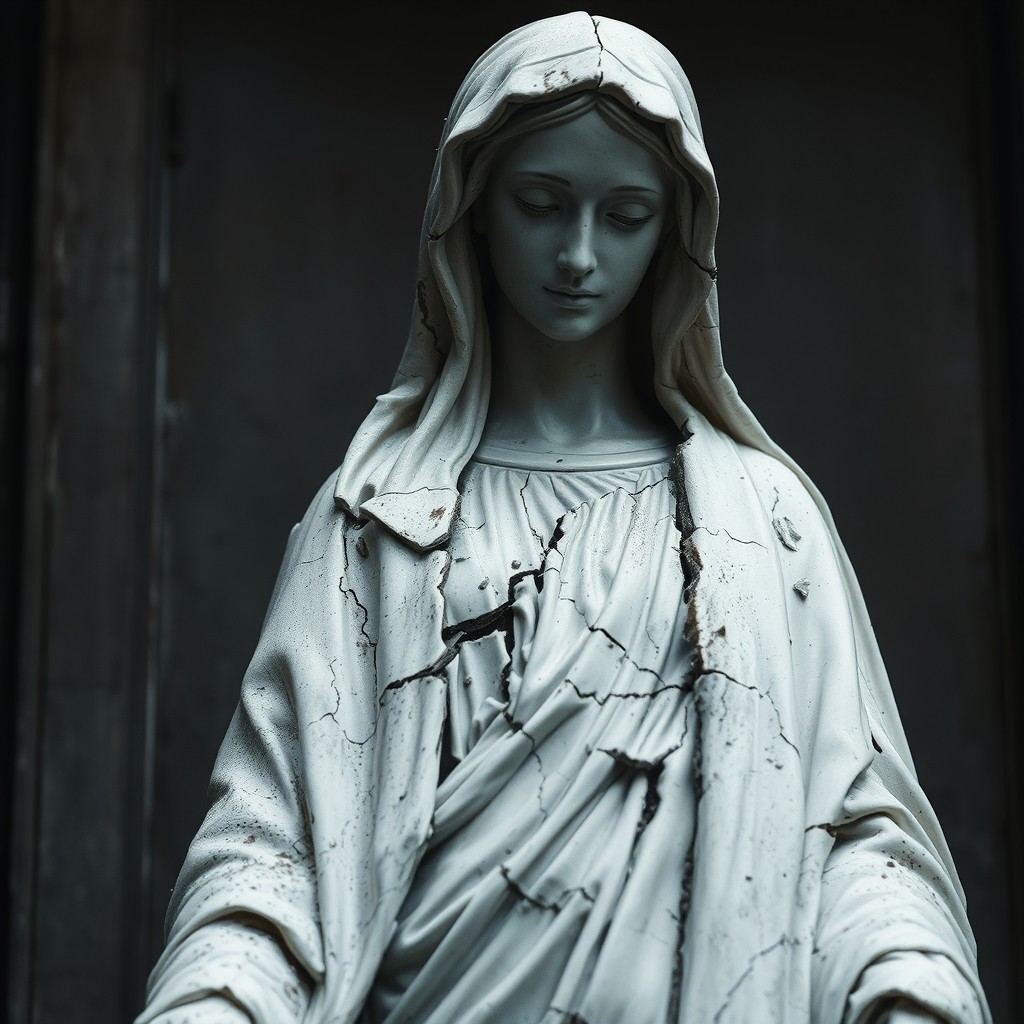
The church of money looks eternal from the outside. Every cathedral does, right up until the morning its people stop believing. Ours is already showing cracks. You can see them in the tiredness on my neighbor's face, in the doorways filling up downtown, in the quiet arithmetic of families deciding what to go without this month. The question is not whether the walls are sound. The question is whether we remember, in time, that we were the ones holding them up.
So I will keep taking my walks. I will keep asking my neighbors how they really are, and I will keep refusing the small smile that tells me to look away. That refusal is a small thing. But every reformation in history began with ordinary people, standing in ordinary places, deciding they would no longer pretend not to see.